Make Americe an Anarcho syndicate Commune Again
Anarcho-syndicalism [i] is a political philosophy and anarchist schoolhouse of thought that views revolutionary industrial unionism or syndicalism every bit a method for workers in capitalist society to gain command of an economic system and thus command influence in broader society. The end goal of syndicalism is to abolish the wage system, regarding it as wage slavery. Anarcho-syndicalist theory generally focuses on the labour movement.[two] Reflecting the anarchist philosophy from which it draws its primary inspiration, anarcho-syndicalism is centered on the thought that power corrupts and that whatever hierarchy that cannot be ethically justified must be dismantled.[3]
The bones principles of anarcho-syndicalism are solidarity, direct action (action undertaken without the intervention of third parties such every bit politicians, bureaucrats and arbitrators) and direct democracy, or workers' self-direction. Anarcho-syndicalists believe their economical theories plant a strategy for facilitating proletarian self-action and creating an alternative branch economical arrangement with democratic values and production that is centered on coming together human needs. Anarcho-syndicalists perceive the chief purpose of the country as the defence force of private property in the forms of capital goods and therefore of economic, social and political privilege. In maintaining this status quo, the state denies most of its citizens the ability to enjoy material independence and the social autonomy that springs from it.[three]
History [edit]
Origins [edit]

The 1910 Congress in which the Spanish CNT was established
Hubert Lagardelle wrote that Pierre-Joseph Proudhon laid out fundamental ideas of anarcho-syndicalism and repudiated both commercialism and the state in the procedure since he viewed costless economical groups and struggle, not pacifism, as dominant in humans.[4]
In September 1903 and March 1904, Sam Mainwaring published in Great britain two issues of a short-lived newspaper called The General Strike, a publication that made detailed criticisms of the "officialism" of union bureaucracy and publicized strikes in Europe making apply of syndicalist tactics.[five]
International Workers' Association [edit]
In 1910, the Confederación Nacional del Trabajo (CNT) was founded in the middle of the restoration in Barcelona in a congress of the Catalan trade union Solidaridad Obrera (Workers' Solidarity) with the objective of constituting an opposing strength to the then-bulk merchandise matrimony, the socialist Unión Full general de Trabajadores (UGT) and "to speed up the economic emancipation of the working class through the revolutionary expropriation of the bourgeoisie". The CNT started small, counting 26,571 members represented through several trade unions and other confederations.[6] In 1911, coinciding with its commencement congress, the CNT initiated a general strike that provoked a Barcelona judge to declare the union illegal until 1914. Also in 1911, the trade union adopted its name formally.[6] From 1918 on, the CNT grew stronger and had an outstanding role in the events of the La Canadiense general strike, which paralyzed 70% of manufacture in Catalonia in 1919, the yr the CNT reached a membership of 700,000.[7] Effectually that time, panic spread among employers, giving rising to the exercise of pistolerismo (employing thugs to intimidate active unionists), causing a spiral of violence that significantly affected the trade matrimony. These pistoleros are credited with killing 21 union leaders in 48 hours.[8]

In 1922, the International Workers' Clan (IWA) was founded in Berlin and the CNT joined immediately, but with the rising of Miguel Primo de Rivera's dictatorship the labor union was outlawed in one case once again the following twelvemonth.[9] However, with the workers' movement resurgent following the Russian Revolution, what was to become the modern IWA was formed, billing itself as the "truthful heir" of the original International.[10] The successful Bolshevik-led revolution of 1917 in Russian federation was mirrored past a wave of syndicalist successes worldwide, including the struggle of the Industrial Workers of the World (IWW) in the The states aslope the creation of mass agitator unions beyond Latin America and huge syndicalist-led strikes in Federal republic of germany, Portugal, Spain, Italy and France, where it was noted that "neutral (economic, but not political) syndicalism had been swept away".[11] The final formation of this new international, then known as the International Workingmen's Clan, took place at an illegal conference in Berlin in December 1922, marking an irrevocable break between the international syndicalist motility and the Bolsheviks.[xi] The IWA included the Italian Syndicalist Union (500,000 members), the Argentine Workers Regional Arrangement (200,000 members), the General Confederation of Workers in Portugal (150,000 members), the Free Workers' Union of Germany (120,000 members), the Committee for the Defence of Revolutionary Syndicalism in France (100,000 members), the Federation du Combattant from Paris (32,000 members), the Central Organisation of the Workers of Sweden (32,000 members), the National Labor Secretariat of the Netherlands (22,500 members), the Industrial Workers of the World in Chile (twenty,000 members) and the Wedlock for Syndicalist Propaganda in Denmark (600 members).[12]
The first secretaries of the International included the famed author and activist Rudolph Rocker, along with Augustin Souchy and Alexander Schapiro. Following the first congress, other groups affiliated from France, Austria, Denmark, Belgium, Switzerland, Bulgaria, Poland and Romania. Afterward, a bloc of unions in the U.s., Colombia, Peru, Ecuador, Republic of guatemala, Cuba, Costa Rica and Republic of el salvador also shared the IWA's statutes. The biggest syndicalist marriage in the United States, the IWW, considered joining merely somewhen ruled out affiliation in 1936 based on the IWA'southward religious and political affiliation policies.[13] Although not anarcho-syndicalist, the IWW were informed past developments in the broader revolutionary syndicalist milieu at the turn of the 20th century. At its founding congress in 1905, influential members with strong anarchist or anarcho-syndicalist sympathies like Thomas J. Hagerty, William Trautmann and Lucy Parsons contributed to the matrimony'southward overall revolutionary syndicalist orientation.[14] Although the terms anarcho-syndicalism and revolutionary syndicalism are ofttimes used interchangeably, the anarcho-syndicalist characterization was non widely used until the early 1920s: "The term 'anarcho-syndicalist' simply came into wide use in 1921–1922 when information technology was applied polemically as a pejorative term by communists to whatsoever syndicalists…who opposed increased command of syndicalism by the communist parties".[15] In fact, depending on the translation the original statement of aims and principles of the IWA (drafted in 1922) refers not to anarcho-syndicalism, but to revolutionary syndicalism or revolutionary unionism.[16] [17]
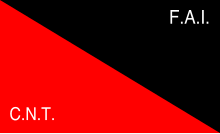
The Biennio Rosso (English: "Red Biennium") was a two-year period between 1919 and 1920 of intense social conflict in Italy following the World War I.[eighteen] The Biennio Rosso took place in a context of economic crisis at the end of the war, with loftier unemployment and political instability. It was characterized past mass strikes, worker manifestations equally well as cocky-management experiments through country and factories occupations.[xviii] In Turin and Milan, workers councils were formed and many factory occupations took place under the leadership of anarcho-syndicalists. The agitations likewise extended to the agricultural areas of the Padan apparently and were accompanied by peasant strikes, rural unrests and guerilla conflicts between left-wing and right-wing militias. According to libcom.org, the anarcho-syndicalist trade marriage Unione Sindacale Italiana (USI) "grew to 800,000 members and the influence of the Italian Agitator Wedlock (20,000 members plus Umanita Nova, its daily paper) grew accordingly [...] Anarchists were the first to suggest occupying workplaces".[19]
Many of the largest members of the IWA were cleaved, driven underground or wiped out in the 1920s–1930s equally fascists came to ability in states across Europe and workers switched abroad from riot towards the seeming success of the Bolshevik model of socialism. In Argentina, the FORA had already begun a process of turn down by the fourth dimension it joined the IWA, having carve up in 1915 into pro and anti-Bolshevik factions. From 1922, the agitator motion there lost most of its membership, exacerbated by farther splits, well-nigh notably around the Severino Di Giovanni thing. It was crushed past General Uriburu's war machine coup in 1930.[xx] Federal republic of germany's FAUD struggled throughout the late 1920s and early 1930s as the Brownshirts took command of the streets. Its last national congress in Erfurt in March 1932 saw the wedlock effort to form an underground bureau to combat Adolf Hitler's fascists, a measure that was never put into exercise as mass arrests decimated the conspirators' ranks.[21] The editor of the FAUD organ Der Syndikalist, Gerhard Wartenberg, was killed in Sachsenhausen concentration military camp. Karl Windhoff, delegate to the IWA Madrid congress of 1931, was driven out of his heed and also died in a Nazi death campsite. At that place were also mass trials of FAUD members held in Wuppertal and Rhenanie, many of these never survived the decease camps.[12] Italian IWA marriage USI, which had claimed a membership of upward to 600,000 people in 1922, was waning even at that fourth dimension of murders and repression from Benito Mussolini'southward fascists.[22] It had been driven underground past 1924 and although information technology was still able to lead pregnant strikes by miners, metalworkers and marble workers, Mussolini'due south ascent to ability in 1925 sealed its fate. By 1927, its leading activists had been arrested or exiled.[23]
Portugal'south CGT was driven underground after an unsuccessful attempt to interruption the newly installed dictatorship of Gomes da Costa with a full general strike in 1927 that led to almost 100 deaths. It survived underground with 15,–20,000 members until January 1934, when information technology called a full general revolutionary strike against plans to supercede trade unions with fascist corporations, which failed. Information technology was able to continue in a much reduced country until World State of war 2, but was effectively finished as a fighting spousal relationship.[24] Massive government repression repeated such defeats around the globe every bit anarcho-syndicalist unions were destroyed in Peru, Brazil, Colombia, Japan, Cuba, Bulgaria, Paraguay and Bolivia. By the end of the 1930s, legal anarcho-syndicalist trade unions existed only in Republic of chile, Republic of bolivia, Sweden and Uruguay.[eleven] However, perhaps the greatest blow was struck in the Spanish Civil War, which saw the CNT, then challenge a membership of 1.58 million, driven clandestine with the defeat of the Spanish Republic by Francisco Franco. The sixth IWA congress took place in 1936, shortly after the Spanish Revolution had begun, but was unable to provide serious fabric support for the section. The IWA held its final pre-state of war congress in Paris in 1938, with months to get earlier the German language invasion of Poland it received an application from ZZZ,[25] a syndicalist wedlock in the country claiming up to 130,000 workers—ZZZ members went on to form a core part of the resistance against the Nazis and participated in the Warsaw uprising. Even so, the International was not to meet once again until 1951, vi years later World War 2 had ended. During the state of war, only ane member of the IWA was able to continue to function as a revolutionary union, the SAC in Sweden.[12] In 1927, with the "moderate" positioning of some cenetistas (CNT members) the Federación Anarquista Ibérica (FAI), an association of anarchist analogousness groups, was created in Valencia. The FAI would play an of import function during the following years through the and so-chosen trabazón (connexion) with the CNT; that is, the presence of FAI elements in the CNT, encouraging the labor union not to movement abroad from its anarchist principles, an influence that continues today.[26]
Castilian Revolution [edit]

Evolution of the number of affiliates in the CNT from 1911 to 1937
On one June 1936, the CNT joined the UGT in declaring a strike of "building workers, mechanics, and elevator operators". A demonstration was held, 70,000 workers strong. Members of the Falange attacked the strikers. The strikers responded by looting shops, and the police reacted by attempting to suppress the strike. By the beginning of July, the CNT was still fighting while the UGT had agreed to arbitration. In retaliation to the attacks past the Falangists, anarchists killed three bodyguards of the Falangist leader José Antonio Primo de Rivera. The government then airtight the CNT's centers in Madrid and arrested David Antona and Cipriano Mera, two CNT militants.[27]
George Orwell wrote of the nature of the new society that arose in the communities:
I had dropped more than or less by take a chance into the only community of whatever size in Western Europe where political consciousness and disbelief in capitalism were more than normal than their opposites. Upward here in Aragón one was among tens of thousands of people, mainly though not entirely of working-class origin, all living at the same level and mingling on terms of equality. In theory it was perfect equality, and fifty-fifty in practise it was not far from it. There is a sense in which information technology would be truthful to say that one was experiencing a foretaste of Socialism, by which I hateful that the prevailing mental atmosphere was that of Socialism. Many of the normal motives of civilised life– snobbishness, money-grubbing, fearfulness of the boss, etc.– had simply ceased to be. The ordinary class-partitioning of society had disappeared to an extent that is almost unthinkable in the money-tainted air of England; there was no one in that location except the peasants and ourselves, and no one owned anyone else equally his master.
—George Orwell, Homage to Catalonia, ch. VII
Some of the most of import communities in this respect were those of Alcañiz, Calanda, Alcorisa, Valderrobres, Fraga or Alcampel. Not only were the lands collectivized, but collective labours were also undertaken, like the retirement home in Fraga, the collectivization of some hospitals (such as in Barbastro or Binéfar) and the founding of schools such as the School of Agitator Militants. These institutions would exist destroyed by the Nationalist troops during the war.
The Committee held an extraordinary regional plenary session to protect the new rural system, gathering all the union representatives from the supporting villages and backed by Buenaventura Durruti. Confronting the volition of the mainly Catalan CNT National Committee, the Regional Defence Council of Aragon was created. Following Largo Caballero's supposition of the position of Prime number Minister of the government, he invited the CNT to bring together in the coalition of groups making up the national government. The CNT proposed instead that a National Defense Council should be formed, led by Largo Caballero; and containing five members each from the CNT and UGT and four "liberal republicans". When this proposal was declined, the CNT decided non to join the authorities. Still, in Catalonia the CNT joined the Fundamental Committee of the Anti-Fascist Militias, which joined the Generalitat on 26 September. For the beginning time, three members of the CNT were too members of the government.[28]
In November, Caballero one time once more asked the CNT to go part of the government. The leadership of the CNT requested the finance and state of war ministries every bit well as three others, simply were given four posts, the ministries of wellness, justice, manufacture and commerce. Federica Montseny became Government minister of Health, the first female person minister in Espana. As minister of justice, Juan García Oliver abolished legal fees and destroyed all criminal files. Shortly afterwards, despite the disapproval of the anarchist ministers the upper-case letter was moved from Madrid to Valencia.[29] On 23 Dec 1936, after receiving in Madrid a retinue formed by Joaquín Ascaso, Miguel Chueca and three republican and independent leaders, the authorities of Largo Caballero, which by and so had iv anarchists every bit ministers (García Oliver, Juan López, Federica Montseny and Joan Peiró), approved the germination of the National Defence force Committee. Information technology was a revolutionary torso that represented anarchists as much as socialists and republicans. Halfway through February 1937, a congress took place in Caspe with the purpose of creating the Regional Federation of Collectives of Aragon. 456 delegates, representing more than than 141,000 collective members, attended the congress. The congress was besides attended past delegates of the National Committee of the CNT.[30]
At a plenary session of the CNT in March 1937, the national committee asked for a motion of censure to suppress the Aragonese Regional Quango. The Aragonese regional committee threatened to resign, which thwarted the censure effort. Although there had always been disagreements, that spring also saw a dandy escalation in confrontations betwixt the CNT-FAI and the Communists. In Madrid, Melchor Rodríguez, who was and so a member of the CNT and director of prisons in Madrid, published accusations that the Communist José Cazorla, who was then overseeing public order, was maintaining secret prisons to agree anarchists, socialists and other republicans; and either executing, or torturing them as "traitors". Presently after, on this pretext Largo Caballero dissolved the Communist-controlled Junta de Defensa.[31] Cazorla reacted by closing the offices of Solidaridad Obrera.[32]

CNT poster informing about the socialization of the Textiles industry
The next 24-hour interval, CNT'due south regional committee declared a full general strike. The CNT controlled the majority of the city, including the heavy arms on the hill of Montjuïc overlooking the city. CNT militias disarmed more than 200 members of the security forces at their barricades, allowing merely CNT vehicles to pass through.[33] After unsuccessful appeals from the CNT leadership to end the fighting, the regime began transferring Attack Guard from the front to Barcelona, and even destroyers from Valencia. On 5 May, the Friends of Durruti issued a pamphlet calling for "disarming of the paramilitary constabulary… dissolution of the political parties…" and declared "Long alive the social revolution! – Downwardly with the counter-revolution!", though the pamphlet was apace denounced by the leadership of the CNT.[34] The next twenty-four hour period, the government agreed to a proposal by the leadership of the CNT-FAI that called for the removal of the Assault Guards and no reprisals confronting libertarians that had participated in the conflict in exchange for the dismantling of barricades and end of the general strike. However, neither the PSUC nor the Assault Guards gave upward their positions and co-ordinate to historian Antony Beevor "carried out violent reprisals against libertarians".[35] Past 8 May, the fighting was over.
These events, the autumn of Largo Caballero's government and the new prime ministership of Juan Negrín shortly led to the collapse of much that the CNT had achieved immediately following the rising the previous July. At the beginning of July, the Aragonese organizations of the Popular Front publicly declared their support for the alternative council in Aragon, led by their president, Joaquín Ascaso. 4 weeks later, the 11th Division under Enrique Líster entered the region. On 11 Baronial 1937, the Republican regime, now situated in Valencia, dismissed the Regional Quango for the Defence force of Aragon.[36] Líster's segmentation was prepared for an offensive on the Aragonese front, but they were besides sent to subdue the collectives run by the CNT-UGT and in dismantling the commonage structures created the previous twelve months. The offices of the CNT were destroyed and all the equipment belonging to its collectives was redistributed to landowners.[36] The CNT leadership not merely refused to allow the anarchist columns on the Aragon front end to go out the front to defend the collectives, only they failed to condemn the government'south actions against the collectives, causing much disharmonize between it and the rank and file membership of the union.[37]
In Apr 1938, Juan Negrín was asked to form a regime and included Segundo Blanco, a fellow member of the CNT, as government minister of instruction; and by this signal, the only CNT member left in the cabinet. At this point, many in the CNT leadership were critical of participation in the government, seeing it as dominated by the Communists. Prominent CNT leaders went so far as to refer to Blanco every bit "sop of the libertarian motion"[38] and "merely one more Negrínist".[39] On the other side, Blanco was responsible for installing other CNT members into the ministry of education and stopping the spread of "Communist propaganda" by the ministry.[40] In March 1939, with the war about over, CNT leaders participated in the National Defence Council'due south coup overthrowing the authorities of the Socialist Juan Negrín.[41] Those involved included the CNT'due south Eduardo Val and José Manuel González Marín serving on the council, while Cipriano Mera's 70th Sectionalisation provided war machine support, and Melechor Rodríquez became mayor of Madrid.[42] The Council attempted to negotiate a peace with Franco, though he granted virtually none of their demands.
Post–World War Two era [edit]

After World War Two, an appeal in the Fraye Arbeter Shtime, detailing the plight of High german anarchists, called for Americans to back up them.[43] By February 1946, the sending of aid parcels to anarchists in Frg was a large-scale operation. In 1947, Rudolf Rocker published Zur Betrachtung der Lage in Federal republic of germany (Regarding the Portrayal of the State of affairs in Germany) about the impossibility of another anarchist movement in Germany. It became the first post-World War II agitator writing to be distributed in Deutschland. Rocker thought immature Germans were all either totally cynical or inclined to fascism and awaited a new generation to grow up before anarchism could bloom once again in the state. Nevertheless, the Federation of Libertarian Socialists (FFS) was founded in 1947 by sometime FAUD members. Rocker wrote for its organ, Die Freie Gesellschaft, which survived until 1953.[44] In 1949, Rocker published some other well-known work. On 10 September 1958, Rocker died in the Mohegan Colony. The Syndicalist Workers' Federation was a syndicalist grouping in active in post-war Britain[45] and i of the Solidarity Federation's earliest predecessors. It was formed in 1950 past members of the dissolved Anarchist Federation of Britain.[45] Unlike the AFB, which was influenced by anarcho-syndicalist ideas but ultimately not syndicalist itself, the SWF decided to pursue a more definitely syndicalist, worker-centred strategy from the kickoff.[45] The Confédération nationale du travail (CNT, or National Confederation of Labour) was founded in 1946 by Castilian anarcho-syndicalists in exile with one-time members of the CGT-SR. The CNT later dissever into the CNT-Vignoles and the CNT-AIT, which is the French department of the IWA.
At the seventh congress in Toulouse in 1951, a much smaller IWA was relaunched again without the CNT, which would not be strong enough to reclaim membership until 1958 as an exiled and underground organization. Delegates attended, though mostly representing very small groups, from Cuba, Argentina, Spain, Sweden, France, Italian republic, Germany, holland, Austria, Kingdom of denmark, Norway, United kingdom, Bulgaria and Portugal. A bulletin of back up was received from Uruguay, simply the situation remained difficult for the International equally it struggled to bargain with the rise of state-sanctioned economical trade unionism in the Westward, heavy clandestine service intervention every bit Common cold War anti-communism reached its height and the banning of all strikes and free trade unions in the Soviet Union bloc of countries.[12] At the 10th congress in 1958, the SAC's response to these pressures led it into a clash with the remainder of the international. Information technology withdrew from the IWA post-obit its failure to better the body's statutes to permit it to stand in municipal elections[46] and amidst concerns over its integration with the state over distribution of unemployment benefits.[47] For nearly of the adjacent two decades, the international struggled to prebuild itself. In 1976 at the 15th congress, the IWA had simply 5 member groups, two of which (the Spanish and Bulgarian members) were still operating in exile (though post-obit Franco'southward death in 1975, the CNT was already approaching a membership of 200,000).[22]
The Direct Action Movement was formed in 1979, when the one remaining SWF co-operative, along with other smaller anarchist groups, decided to form a new arrangement of anarcho-syndicalists in Britain.[48] The DAM was highly involved in the Miners' Strike besides equally a series of industrial disputes afterwards in the 1980s, including the Ardbride dispute in Ardrossan, Scotland, involving a supplier to Laura Ashley, for which the DAM received international support. From 1988 in Scotland, and so England and Wales, the DAM was active in opposing the Poll Tax.[49] In March 1994, DAM changed to its current name, the Solidarity Federation, having previously been the Direct Activity Movement since 1979 and before that the Syndicalist Workers' Federation since 1950. Presently, the Solidarity Federation publishes the quarterly magazine Straight Action (presently on hiatus) and the newspaper Goad.[50] In 1979, a split up over representative unionism, professional unionism and state-funded schemes saw the CNT divided into two sections, the CNT as information technology is today and the Confederacion Full general del Trabajo. Afterward Franco's decease in Nov 1975 and the showtime of Espana'south transition to democracy, the CNT was the only social movement to refuse to sign the 1977 Moncloa Pact,[51] an understanding amongst politicians, political parties and trade unions to plan how to operate the economy during the transition. In 1979, the CNT held its first congress since 1936 besides as several mass meetings, the well-nigh remarkable one in Montjuïc. Views put forward in this congress would set the blueprint for the CNT'southward line of action for the following decades: no participation in union elections, no acceptance of state subsidies,[52] no acknowledgment of works councils and back up of union sections.
In this first congress, held in Madrid,[53] a minority sector in favor of union elections split from the CNT, initially calling themselves CNT Valencia Congress (referring to the alternative congress held in this city) and afterwards Confederación General del Trabajo (CGT) subsequently an April 1989 court decision determined that they could not use the CNT initials.[54] In 1990, a grouping of CGT members left this spousal relationship considering they rejected the CGT's policy of accepting government subsidies, founding Solidaridad Obrera. Ane yr earlier, the 1978 Scala Case affected the CNT. An explosion killed 3 people in a Barcelona night gild.[55] The authorities alleged that striking workers "blew themselves up" and arrested surviving strikers, implicating them in the criminal offense.[56] CNT members declared that the prosecution sought to criminalize their organization.[57]
Gimmicky times [edit]

Members of the Spanish anarcho-syndicalist trade union CNT marching in Madrid in 2010
After its legalization, the CNT began efforts to recover the expropriations of 1939. The ground for such recovery would exist established by Law four/1986, which required the return of the seized properties and the unions' right to utilize or yield the existent manor. Since then, the CNT has been claiming the return of these properties from the State. In 1996, the Economic and Social Council facilities in Madrid were squatted by 105 CNT militants.[58] This body is in charge of the repatriation of the accumulated spousal relationship wealth. In 2004, an understanding was reached between the CNT and the District Attorney's Office, through which all charges were dropped against the hundred prosecuted for this occupation.

On 3 September 2009, six members of the Serbian IWA section (ASI-MUR), including and then-IWA General Secretary Ratibor Trivunac, were arrested[59] on suspicion of international terrorism, a charge that was heavily disputed by the international and other agitator groups. Presently subsequently their abort, an open letter was circulated[60] by Serbian academics criticizing the charges and the attitude of Serbian police. The vi were formally indicted on 7 December and after a lengthy trial procedure Trivunac, along with other five anarchists, were freed on 17 Feb 2010. On 10 December 2009, the FAU local in Berlin was effectively banned as a union following a public industrial dispute at the city's Babylon movie theatre. At the XXIV annual congress of the IWA which was held in Brazil in December 2009, the first time the congress had been held exterior Europe, motions of back up were passed for the "Belgrade Vi" and FAU while members of the Solidarity Federation temporarily took over duties equally Secretariat. The International's Norwegian section subsequently took on the Secretariat office in 2010. As part of the anti-thrift move in Europe, various IWA sections have been highly active in the 2008–2012 period, with the CNT taking a leading role in agitating for the general strikes that have occurred in Spain, the USI in Milan taking on anti-austerity campaigns in the health service and the ZSP organizing tenants against abuses in rented accommodation.[61]
The largest organised anarchist movement today is in Spain in the form of the Confederación General del Trabajo (CGT) and the CNT. CGT membership was estimated at around 100,000 for 2003.[62] The regions with the largest CNT membership are the Middle (Madrid and surrounding surface area), the North (Basque country), Andalucía, Catalonia and the Balearic Islands.[63] The CNT opposes the model of union elections and workplace committees[64] and is critical of labor reforms and the UGT and the CCOO,[65] standing instead on a platform of reivindicación; that is, "return of what is due", or social revolution.[66]
The following organizations are anarcho-syndicalist and revolutionary syndicalist federations and trade unions from all around the earth.[67]
| Land | Name | Acronym | Publications | Affiliation |
|---|---|---|---|---|
 Argentine republic Argentine republic | Federacion Obrera Regional Argentina | FORA | Organizacion Obrera | ICL |
 Australia Australia | Anarcho-Syndicalist Federation and Industrial Workers of the World | ASF and IWW | IWA | |
 Austria Austria | Wiener ArbeiterInnen Syndikat & Industrial Workers of the Earth | WAS and IWW | IWA and ICL | |
 People's republic of bangladesh People's republic of bangladesh | Bangladesh Anarcho-Syndicalist Federation | BASF | IWA | |
 Brazil Brazil | Confederação Operária Brasileira and Federação das Organizações Sindicalistas Revolucionárias do Brasil | COB and FOB | A Voz do Trabalhador, A Plebe | IWA and ICL |
 Bulgaria Bulgaria | Autonomous Workers' Matrimony and Autonomous Workers' Confederation | ARS and ARK | IWA and ICL | |
 Canada Canada | Industrial Workers of the Globe | IWW | ICL | |
 Republic of chile Republic of chile | Germinal | G | IWA | |
 Colombia Colombia | Libertarian Wedlock of Students and Labor | ULET | IWA | |
 Croatia Croatia | Mreža anarhosindikalista | MASA-HR | ||
 France France | Confédération nationale du travail | CNTF-AIT | IWA | |
 Federal republic of germany Federal republic of germany | Complimentary Workers' Wedlock, Industrial Workers of the Globe and Gefangenen Gewerkschaft-Bundesweite Organization | FAU, IWW and GG-BO | ICL | |
 Greece Greece | Anarcho-Syndicalist Initiative-Rocinante, Libertarian Syndicalist Union & Industrial Workers of the World | AP-R, ESE & IWW | ICL | |
 Iceland Iceland | Industrial Workers of the World | IWW | ||
 Italy Italy | Unione Sindacale Italiana | USI | ICL | |
 India India | Muktivadi Ekta Morcha | MEM | IWA | |
 Indonesia Indonesia | Persaudaraan Pekerja Anarko Sindikalis | PPAS | IWA | |
 Ireland Ireland | Industrial Workers of the Globe | IWW | ||
 Lithuania Lithuania | Industrial Workers of the Globe | IWW | ||
 Netherlands Netherlands | Free Wedlock | VB | ICL | |
 Nigeria Nigeria | Awareness League | AL | ||
 Kingdom of norway Kingdom of norway | Norsk Syndikalistisk Forbund | NSF-IAA | IWA | |
 Poland Poland | Związek Syndykalistów Polski and Workers' Initiative | ZSP-MSP | Zapłata | IWA & ICL |
 Portugal Portugal | AIT-Secção Portuguesa | AIT-SP | Anarcho Sindicalista | IWA |
 Romania Romania | Anarcho-Syndicalist Initiative | IAS | ||
 Russia Russia | Confederation of Revolutionary Anarcho-Syndicalists | KRAS-MAT | Прямое действие (Direct Activity) | IWA |
 Serbia Serbia | Anarho-sindikalistička inicijativa | ASI-MUR | Direktna akcija | IWA |
 Slovakia Slovakia | Priama Akcia | PA-MAP | IWA | |
 Spain Spain | Confederación Nacional del Trabajo, Confederación Full general del Trabajo and Solidaridad Obrera | CNT-AIT, CGT and And so | IWA & ICL | |
 Switzerland Switzerland | Industrial Workers of the World | IWW | ||
 Sweden Sweden | Örestad Lokala Samorganisation, Central Organisation of the Workers of Sweden and Swedish Anarcho-syndicalist Youth Federation | OLS, SAC and SUF | Arbetaren | IWA |
 Turkey Turkey | Industrial Workers of the Globe | IWW | ICL | |
 United Kingdom United Kingdom | Solidarity Federation, Industrial Workers of the Globe and United Voices of the Earth | SF-IWA, IWW and UVW | Straight Action, Catalyst | IWA and ICL |
 Usa Usa | Workers' Solidarity Alliance and Industrial Workers of the World | WSA & IWW | IWA and ICL |
Green syndicalism [edit]
Green syndicalism is a synthesis of anarcho-syndicalism and environmentalism, arguing that protection of the surroundings depends on decentralization, regionalism, direct action, autonomy, pluralism and federation. It largely draws inspiration from the green bans in Australia, the efforts of workers at Lucas Aerospace to catechumen their factories away from armaments production and Judi Bari's efforts in the IWW to organise timber workers and environmentalists in Northern California. Greenish Syndicalism has been advocated for at various times by Confédération Nationale du Travail, Confederación General de Trabajadores and the Central Organisation of the Workers of Sweden.[68]
Theory and politics [edit]

Rudolf Rocker, influential anarcho-syndicalist writer and activist

Bones outline of syndicalism as an economic system
Anarcho-syndicalists believe that straight action—activeness carried out by workers as opposed to indirect action, such as electing a representative to a authorities position—would permit workers to liberate themselves.[69]
Anarcho-syndicalists believe that workers' organisations that oppose the wage arrangement will eventually form the basis of a new society and should be self-managing. They should not take bosses or "business agents"; rather, the workers alone should make up one's mind on that which affects them.[seventy] Rudolf Rocker is one of the most influential figures in the anarcho-syndicalist movement.
Noam Chomsky, who was influenced past Rocker, wrote the introduction to a modern edition of Anarcho-syndicalism: Theory and Do. A fellow member of the Industrial Workers of the Globe (IWW), Chomsky is a cocky-described anarcho-syndicalist, a position that he sees as the appropriate awarding of classical liberal political theory to contemporary industrial gild:
Now a federated, decentralised arrangement of free associations, incorporating economic as well as other social institutions, would exist what I refer to as anarcho-syndicalism; and it seems to me that this is the advisable course of social organization for an avant-garde technological gild in which human beings do not have to exist forced into the position of tools, of cogs in the machine. There is no longer any social necessity for human beings to be treated every bit mechanical elements in the productive procedure; that can be overcome and nosotros must overcome it to exist a society of freedom and gratis association, in which the creative urge that I consider intrinsic to human nature will in fact be able to realize itself in whatever mode information technology will.[71]
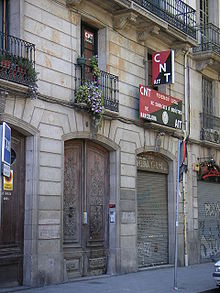
CNT'southward offices in Barcelona
Criticism and response [edit]
Anarcho-syndicalism has been criticised every bit anachronistic past some contemporary anarchists.[72] In 1992, Murray Bookchin spoke against its reliance on an outdated view of work:
As "practical" and "realistic" as anarcho-syndicalism may seem, it represents in my view an archaic ideology rooted in a narrowly economistic notion of conservative interest, indeed of a sectorial involvement as such. It relies on the persistence of social forces like the factory organization and the traditional class consciousness of the industrial proletariat that are waning radically in the Euro-American world in an era of indefinable social relations and always-broadening social concerns. Broader movements and bug are now on the horizon of modern club that, while they must necessarily involve workers, crave a perspective that is larger than the factory, merchandise union, and a proletarian orientation.[73]

Anarchists and anarcho-syndicalists in Brazil on 15 May 2019
Bookchin has said that it prioritizes the interests of the working class, instead of communal freedom for society as a whole; and that this view ultimately prevents a truthful revolution. He argues that in instances like the Castilian Revolution, it was in spite of the syndicalist-minded CNT leadership that the revolution occurred.[73]
Direct activity, being one of the chief staples of anarcho-syndicalism, would extend into the political sphere according to its supporters. To them, the labour quango is the federation of all workplace branches of all industries in a geographical area "territorial ground of organisation linkage brought all the workers from one area together and fomented working-class solidarity over and earlier corporate solidarity".[74] Rudolf Rocker argued:
The arrangement of Anarcho-Syndicalism is based upon the principles of Federalism, on complimentary combination from below upwards, putting the right of self-decision of every member above everything else and recognising only the organic agreement of all on the basis of like interests and common convictions.[75]
Anarcho-syndicalism therefore is non apolitical only instead sees political and economical activity as the aforementioned. Dissimilar the propositions of some of its critics, anarcho-syndicalism is different from reformist union activity in that information technology aims to obliterate commercialism every bit "[anarcho-syndicalism] has a double aim: with tireless persistence, it must pursue betterment of the working class's current conditions. But, without letting themselves become obsessed with this passing concern, the workers should take care to make possible and imminent the essential act of comprehensive emancipation: the expropriation of capital".[76]

While collectivist and communist anarchists criticise syndicalism equally having the potential to exclude the voices of citizens and consumers exterior of the union, anarcho-syndicalists argue that labour councils will work outside of the workplace and within the community to encourage community and consumer participation in economic and political activity (even workers and consumers outside of the union or nation) and will work to course and maintain the institutions necessary in any society such as schools, libraries, homes so on. Bookchin argues:
At the same time that syndicalism exerts this unrelenting pressure on commercialism, information technology tries to build the new social order within the old. The unions and the 'labour councils' are not merely means of struggle and instruments of social revolution; they are as well the very structure around which to build a free social club. The workers are to be educated [by their ain activity within the union] in the chore of destroying the old propertied order and in the task of reconstructing a stateless, libertarian society. The 2 go together.[77]
In popular culture [edit]
- The 1975 comedy flick Monty Python and the Holy Grail makes reference to anarcho-syndicalism. King Arthur becomes frustrated when a character named Dennis explains the anarcho-syndicalist district in which he lives. The state of affairs is exacerbated when Dennis insults Arthur's claim to Excalibur and kingship of the Britons. Arthur, fed up, assaults Dennis and leaves, an incident that Dennis refers to every bit "the violence inherent in the arrangement".
- Ursula K. Le Guin's novel The Dispossessed (1974) shows a fictional functioning anarcho-syndicalist society. The novel is subtitled "An Ambiguous Utopia".
- Living Utopia, (Vivir la utopía, documentary-film from 1997 about anarcho-syndicalism and riot in Spain).
- Noam Chomsky's The Relevance of Anarcho-syndicalism (interviewed by Peter Jay, 1976) (video and text).
See likewise [edit]
- General strike
- Kronstadt rebellion
- Libertarian socialism
- List of federations of merchandise unions
- Participatory economics
- Wildcat strike action
- Workers' self-management
- Syndicalism
- Socialism
- left-libertarianism
- Anti-capitalism
- Unionism
References [edit]
- ^ "Syndicalism". "Revolutionary syndicalism". Encyclopædia Britannica. Retrieved 24 December 2019.
- ^ Jeremy Jennings, Syndicalism in France (St Martin'due south Press, 1990) ISBN 031204027X
- ^ a b "1c. Why do anarcho-syndicalists oppose participation in statist politics?". Anarcho-Syndicalism 101. Course Struggle Online. April 2002. Archived from the original on 18 June 2013. Retrieved 20 June 2013.
- ^ Jameson, J. F., The American Historical Review (American Historical Association, 1895), p. 731.
- ^ "The Great Dock Strike of 1889," Straight Activeness #47, 11 August 2009. Retrieved eight March 2010.
- ^ a b Geary, Dick (1989). Labour and Socialist Movements in Europe Before 1914. Berg Publishers. Pg. 261
- ^ Beevor 2006, p. thirteen
- ^ Beevor 2006, p. xv
- ^ Beevor 2006, p. 17
- ^ Wayne Thorpe (1989), The Workers Themselves
- ^ a b c Vadim Damier (2009)
- ^ a b c d "1860-today: The International Workers Clan". Libcom.org. 2006. Retrieved 29 September 2009.
- ^ Fred W. Thompson and Patrick Murfin (1976), IWW: Its Kickoff 70 Years, 1905-1975
- ^ Salvatore Salerno, Ruddy November, Blackness November: Culture and Community in the Industrial Workers of the World (Land University of New York Press, 1989), pp. 69–xc, ISBN 0-7914-0089-one
- ^ David Berry, A History of the French Anarchist Motility, 1917–1945, (Greenwood, 2002), p. 134. ISBN 0-313-32026-8
- ^ "Principles of Revolutionary Syndicalism". Archived 22 December 2007 at the Wayback Machine, Anarcho-Syndicalist Review.
- ^ "The Statutes of Revolutionary Unionism (IWA)" Archived 16 July 2012 at the Wayback Automobile, The International Workers Clan (IWA).
- ^ a b Brunella Dalla Casa, Composizione di classe, rivendicazioni eastward professionalità nelle lotte del "biennio rosso" a Bologna, in: AA. VV, Bologna 1920; le origini del fascismo, a cura di Luciano Casali, Cappelli, Bologna 1982, p. 179.
- ^ "1918–1921: The Italian manufactory occupations - Biennio Rosso" Archived 5 November 2011 at the Wayback Machine on libcom.org
- ^ "Support-Page".
- ^ "Organise Magazine issue 65". Anarchist Federation. 2005. Archived from the original on i December 2008. Retrieved 29 September 2009.
- ^ a b "Global anarcho-syndicalism 1939-99" (PDF). Selfed. 2001. Archived from the original (PDF) on nineteen Feb 2012. Retrieved 29 September 2009.
- ^ G. Careri (1991), L'Unione Sindacale Italiana
- ^ "The IWA today – Due south London DAM". DAM-IWA. 1985. Retrieved 23 April 2011.
- ^ "Riot and the ZZZ in Poland, 1919-1939".
- ^ Roca Martínez 2006, p. 116
- ^ Beevor 2006, p. 48
- ^ Beevor 2006, pp. 146–147
- ^ Beevor 2006, p. 170
- ^ Alexander 1999, p. 361
- ^ Beevor 2006, p. 260
- ^ Beevor 2006, p. 263
- ^ Beevor 2006, pp. 263–264
- ^ Beevor 2006, pp. 266–267
- ^ Beevor 2006, p. 267
- ^ a b Beevor 2006, p. 295
- ^ Beevor 2006, p. 296
- ^ Alexander 1999, p. 976
- ^ Alexander 1999, p. 977
- ^ Alexander 1999, p. 978
- ^ Alexander 1999, p. 1055
- ^ Beevor 2006, p. 490
- ^ Vallance, Margaret (July 1973). "Rudolf Rocker – a biographical sketch". Journal of Gimmicky History. London/Beverly Hills: Sage Publications. 8 (iii): 75–95. doi:x.1177/002200947300800304. ISSN 0022-0094. OCLC 49976309. S2CID 159569041. Vallance 1973, pp. 77–78
- ^ Vallance 1973, pp. 94–95
- ^ a b c Encyclopedia of British and Irish Political Organizations' . United kingdom of great britain and northern ireland: Pinter Publishers. 2000. ISBN978-1855672642.
- ^ SAC had begun battling municipal elections under the candidatures of Libertarian Municipal People
- ^ Michael Schmidt and Lucien Van Der Walt (2009), Blackness Flame
- ^ "The Direct Action Movement".
- ^ Meltzer, Albert (2001). I Couldn't Pigment Gold Angels. United Kingdom: AK Press. ISBN978-1873176931.
- ^ Catalyst.
- ^ Roca Martínez 2006, p. 108
- ^ Roca Martínez 2006, p. 109
- ^ Aguilar Fernández 2002, p. 110
- ^ "FAQ". Archived from the original on ix Feb 2008.
Un sector minoritario que es partidario de las elecciones sindicales se escinde y pasa a llamarse CNT congreso de valencia (en referencia al Congreso alternativo realizado en esa ciudad) y posteriormente, perdidas judicialmente las siglas, a CGT.
- ^ Alexander 1999, p. 1094
- ^ Meltzer 1996, p. 265
- ^ (in Spanish) A series of three manufactures about the Scala Case from the CNT bespeak of view: (one) El Caso Scala. United nations proceso contra el anarcosindicalismo Archived 30 June 2006 at the Wayback Motorcar, ("The Scala Case. A trial against anarcho-syndicalism"), Jesús Martínez, Revista Polémica online, 1 Feb 2006; (2) Segunda parte. El proceso Archived thirty June 2006 at the Wayback Machine ("Second part: the trial") 31 January 2006; (3) Tercera parte. El canto del Grillo Archived 30 June 2006 at the Wayback Machine ("Third office: Grillo's song") 31 Jan 2006. All accessed online half dozen Jan 2008.
- ^ "Los 117 detenidos de la CNT, en libertad tras prestar declaración". El Mundo (in Spanish). 7 Dec 1996. Retrieved 14 Jan 2008.
- ^ "Belgrade: anarchists arrested; state chaser seeks international terrorism charge". libcom.org.
- ^ "Archived copy". Archived from the original on xiv October 2013. Retrieved 15 April 2014.
{{cite spider web}}: CS1 maint: archived copy as title (link) - ^ "The unofficial IWA web log". ASI-MUR. 2011. Retrieved fourteen Oct 2011. keeps an updated list of recent IWA member activities
- ^ Carley, Mark "Trade spousal relationship membership 1993–2003" (International:SPIRE Assembly 2004).
- ^ Beltrán Roca Martínez, "Anarchism, Anthropology and Andalucia", Anarchist Studies fourteen (2).
- ^ (in Spanish) ¿Que son las elecciones sindicales? Archived nine February 2008 at the Wayback Machine, official CNT site. Accessed online 6 January 2008.
- ^ (in Spanish) Otra reforma laboral ¿Y ahora qué? Archived 26 February 2008 at the Wayback Machine, official CNT site. Accessed online half-dozen January 2008.
- ^ (in Spanish) Plataforma Reivindicativa Archived 29 Jan 2008 at the Wayback Machine, official CNT site. Accessed online 6 January 2008.
- ^ [1] IWA Congress 2013
- ^ "Greenish Syndicalism". The Anarchist Library . Retrieved 2 October 2019.
- ^ Rudolf Rocker, Anarcho-Syndicalism: Theory and Practice (AK Press, 2004), p. 73, ISBN 1-902593-92-8
- ^ Rudolf Rocker, Anarcho-Syndicalism: Theory and Practice (AK Printing, 2004), p. 62-63, ISBN 1-902593-92-8
- ^ The Chomsky-Foucault Debate on Human Nature, The New Press, 2006, p.38-9
- ^ Heider, Ulrike and Bode, Ulrike, Riot: Left, Correct and Green (San Francisco: City Lights Books, 1994), p. iv. ISBN 0-87286-289-5
- ^ a b Murray Bookchin, The Ghost of Anarcho-Syndicalism, online at Chaos Archives Archived 3 January 2009 at the Wayback Automobile. Retrieved 27 January 2009.
- ^ Romero Maura, "The Spanish Case", contained in Anarchism Today, D. Apter and J. Joll (eds.), p. 75
- ^ Rudolf Rocker, Anarcho-Syndicalism, op. cit., p. 53
- ^ Emile Pouget in No Gods, No Masters: An Anthology of Riot, edited by Daniel Guerin (AK Press, 2005), p. 71. ISBN 1-904859-25-ix
- ^ Bookchin, M 1998, The Castilian Anarchists, AK Press, California. p 121
Further reading [edit]
- Aguilar Fernández, Palomar (2002). Memory and Amnesia: The Role of the Spanish Ceremonious War in the Transition to Republic. Berghahn Books. ISBNi-57181-496-5.
- Alexander, Robert (1999). The Anarchists in the Spanish Civil War. London: Janus. ISBN1-85756-400-6. OCLC 43717219.
- Beevor, Antony (2006). Battle for Espana the Spanish Civil State of war, 1936-1939. New York: Penguin Books. ISBN0-14-303765-10.
- Roca Martínez, Beltrán (2006). "Anarchism, anthropology and Andalucia: an analysis of the CNT and 'New Capitalism'" (PDF). Agitator Studies. London: Lawrence & Wishart. 14 (2): 106–130. ISSN 0967-3393. Archived from the original (PDF) on 24 September 2020. Retrieved 27 December 2007.
- Meltzer, Albert (1996). I Couldn't Paint Gilt Angels: Threescore Years of Commonplace Life and Agitator Agitation. Oakland: AK Printing. ISBN1-873176-93-seven.
- Blackness Flame: The Revolutionary Course Politics of Riot and Syndicalism (Counter-Power vol 1) by Lucien van der Walt and Michael Schmidt AK Printing. (one Apr 2009). ISBN 978-1-904859-16-1
- Federation, Solidarity, Fighting for ourselves: Anarcho-syndicalism and the course struggle - Solidarity Federation, Freedom Press, 2012 ISBN 978-1904491200
- Flank, Lenny (ed), IWW: A Documentary History, Red and Black Publishers, St Petersburg, Florida, 2007. ISBN 978-0-9791813-5-1
- Rocker, Rudolf, Anarchism and Anarcho-Syndicalism
- Rocker, Rudolf, Anarchosyndicalism: Theory and Practise
- Van Deusen, David, The Rise And Fall of The Green Mountain Anarchist Collective, The Agitator Library, 2015.
- Van Deusen, David & West, Sean & the Green Mount Agitator Collective, Neither Washington Nor Stowe: Common Sense For The Working Vermonter, Catamount Tavern Press, 2004.
External links [edit]
- A comprehensive list of Anarcho-syndicalist organisations
- What is revolutionary syndicalism? An ongoing historical series on anarcho-syndicalism and revolutionary syndicalism from a communist perspective
- Anarcho-Syndicalism 101
- Anarcho-Syndicalist Review
- Syndicalism: Myth and Reality
- Revolutionary Unionism: Yesterday, Today, Tomorrow by Dan Jakopovich
- Anarcho-Syndicalism texts from the Kate Sharpley Library
Source: https://en.wikipedia.org/wiki/Anarcho-syndicalism
0 Response to "Make Americe an Anarcho syndicate Commune Again"
Postar um comentário